


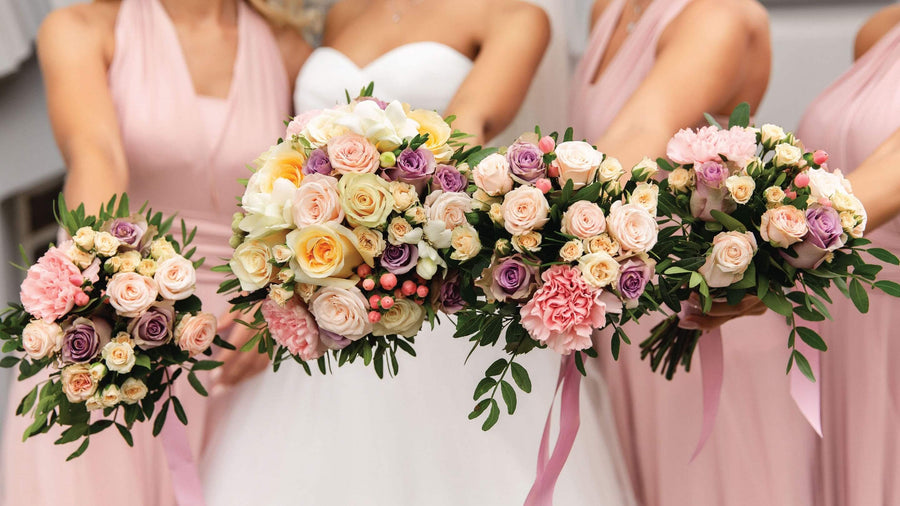


Short answer: in the US cut-flower trade, "fall flowers" is a colour description, not a growing season. Chrysanthemums, dahlias and asters are what bloom outdoors in a North American garden in October. What a florist actually buys for autumn work is roses, carnations, hypericum and foliage grown year-round under Ecuadorian equatorial light — selected or tinted into terracotta, rust, burgundy, amber, mustard and brown. The useful question is not what is in season, but which varieties give you those tones and which ones have to be dyed to get there.
This guide is written for florists, event designers and bulk buyers ordering by the box. Everything linked below is a live product on this site, with the head size, petal count and vase life we publish on the product page.
What flowers are in season in fall?
Two answers, depending on what you mean.
If you are planting a garden: chrysanthemums, asters, dahlias, sedum, goldenrod, ornamental kale and late sunflowers are the autumn bloomers in most US zones.
If you are buying cut flowers wholesale: availability is not seasonal. Our farms sit on the equator at roughly 2,800 metres, where day length barely changes and night temperatures stay cold. Roses, carnations, alstroemeria, hypericum, solidago, craspedia and eucalyptus crop continuously all year. So nothing on a fall order form is there because it is "in season" — it is there because it is the right colour.
That distinction matters commercially. A florist who plans an autumn collection around what is seasonally abundant is designing against a constraint that does not exist for imported stems. The real constraint is colour: roses do not grow brown, mustard or true rust, which is why the autumn palette splits into naturally earth-toned varieties and tinted ones.
What are the fall flower colours for 2026?
Six families cover almost every autumn brief we fill:
- Terracotta and clay — the dominant muted autumn tone for weddings
- Rust and burnt orange — the traditional October colour
- Burgundy and deep berry — the dark anchor in a mixed arrangement
- Amber, gold and mustard — the warm highlight
- Brown and chestnut — the newest of the six and the one that can only be tinted
- Cream and sand — the neutral that stops the other five reading as muddy
Most autumn palettes fail for the same reason: three tones from the same family with nothing light in the mix. A cream or sand rose is doing more work in a rust arrangement than another rust rose is.
Which roses are naturally fall-coloured?
These are grown in autumn tones rather than dyed. Specs are per our own farm data and appear on each product page.
| Variety | Colour | Head | Petals | Vase life |
|---|---|---|---|---|
| Kahala | Terracotta / dusty clay | 5.5–6.2 cm | 44–47 | 18–20 days |
| Coffee Break | Deep terracotta | 5.5–6.5 cm | 40 | 16–17 days |
| Barista | Terracotta, warmer | 5.5–6 cm | 40–45 | 17–19 days |
| Razzmatazz | Terracotta | See product page | ||
| Cherry Brandy | Red-orange with a yellow heart | 5–6 cm | 33–35 | 12–14 days |
| Nina | Burnt orange | 5.5–6 cm | 36–42 | 14–16 days |
| Confidential | Orange | 5.6–7 cm | 35–40 | 16–18 days |
| Free Spirit | Peachy orange | 5–6 cm | 47–49 | 15–16 days |
| Orange Crush | Bright orange, coral tones | 5.5–6 cm | 35–37 | 14–16 days |
| High Magic | Yellow with burnt-red edges | 5.5–6 cm | 40–42 | 14–16 days |
| Sandy | Cream / sand | 5.5–6 cm | 40–44 | 15–17 days |
If you only take two from this table, take Kahala for the terracotta body and Sandy for the neutral. Kahala also has the longest vase life of anything in our autumn range at 18 to 20 days, which is why it survives a Friday delivery for a Sunday event with margin left over.
Which fall roses are tinted, and why does that matter?
Brown, mustard, chestnut and true rust do not occur in roses. Our fall tinted range produces them by absorption tinting: cut stems stand in a dye solution and draw it up through the stem into the petal tissue. The colour ends up inside the petal.
The alternative methods are spraying and airbrushing, which lay pigment on the petal surface. That is the finish that marks hands, linens and tablecloths when arrangements get handled, and it is the reason tinted flowers have a poor reputation with some designers. Absorption does not transfer, and because the flower is never cut open or coated it drinks normally and holds its published vase life — Acorn, for instance, runs 16 to 18 days.
| Tinted variety | What it gives you |
|---|---|
| Acorn | Deep yellow centre fading to brown at the tips |
| Chestnut | The deepest, most solid brown in the range |
| Brown Leaf | Brown fading darker at the tips, like a crisp leaf |
| Cinnamon | Brown with red undertones — bridges rust and burgundy |
| Crispy Leaf | Muted mustard that reads autumn, not spring |
| Amber | Vivid yellow centre with fiery orange tips |
| Golden Fall | Golden yellow into orange, on the densest head in the range |
| Autumn Fest | Even autumn orange — the anchor colour |
| Pumpkin Pie | The brightest orange, with a yellow centre |
| Cranberry | Deep berry red, 62–66 petals, 15–17 day vase life |
| Grafito | True graphite grey, silver edges into charcoal |
What fillers and foliage work for fall arrangements?
Autumn work is carried as much by texture as by colour. The five we ship most in October:
- Hypericum berries — the single most useful autumn filler. Berry clusters read as fruit rather than flower, which is exactly the harvest reference most briefs are reaching for.
- Sunflowers — the one genuinely seasonal signal in the list. Keep them cool and upright: warm horizontal storage bends the heads permanently (UC Davis Postharvest).
- Solidago Golden Glory — mustard-gold spray that fills volume cheaply at $0.70 a stem.
- Craspedia — yellow drumstick heads, graphic and long-lasting, good against brown roses.
- Eucalyptus Baby Blue — the grey-blue cool note that keeps a warm palette from going flat. One handling caveat: eucalyptus emits ethylene when it is warm and water-stressed, so keep it hydrated and cold if it shares a box with carnations or alstroemeria.
Also worth a line on the order: spray roses for small-scale repetition, carnations at $0.54 a stem for volume, and scabiosa for movement.
What are the best flowers for a fall wedding?
Three palettes that have worked repeatedly, each built from stems on this site.
Muted terracotta (the 2026 default)
Kahala as the body, Sandy as the light, Cinnamon for depth, Baby Blue eucalyptus to cool it. Reads expensive in photographs and holds up under warm venue lighting.
Rust and amber (traditional October)
Autumn Fest and Nina for the rust, Amber and craspedia as highlights, hypericum for the berry texture.
Burgundy and brown (the dark one)
Cranberry and Chestnut as the mass, Crispy Leaf mustard as the break, Candlelight cream to lift it. This palette needs the light tone more than the other two — without it the whole arrangement disappears in evening photographs.
How many stems do I need for a fall centerpiece?
Working numbers from the events we supply:
- Low round centerpiece (20–25 cm across): 15–18 rose stems plus 5–7 filler stems
- Tall footed arrangement: 25–30 rose stems plus 10 filler
- Bridal bouquet: 30–40 stems depending on head size — dense varieties like Free Spirit at 47–49 petals need fewer than an open-cut rose
- Bridesmaid bouquet: 12–15 stems
Roses are bunched in 25s, so a 100-stem quarter box is four bunches — roughly six low centerpieces with filler, or two bouquets and three centerpieces. For a 20-table reception, budget 300–350 rose stems plus filler and order the 300-stem half box.
How do I order fall flowers wholesale?
Everything is sold by the stem, bunched in 25s, and cut to order — stems are harvested after you order rather than pulled from a cold room, which is why the published vase life is what you actually get.
- Stem lengths: Small 40–50 cm, Medium 50–60 cm, Large 60–70 cm
- Box sizes: 100 or 125 stems (quarter box), 250 or 300 stems (half box). Minimum order is one box.
- Price: fall tinted roses from $129 per 100 stems ($1.29 a stem), falling to $1.14 a stem at 250. Natural premium varieties from $138 per 100 stems.
- Shipping: charged separately by the box at checkout — $34 a quarter box, $47 a half box — with UPS or FedEx delivery in 3 to 5 business days across the US.
- Lead time: order at least a week before you need the stems in hand. Cut-to-order plus 3 to 5 business days transit is the whole timeline.
Start from the Fall Flowers collection for the full range, or Fall Tinted Roses if you already know you need brown, mustard or chestnut.
Fall flowers: frequently asked questions
What flowers are in season in fall? For garden planting: chrysanthemums, asters, dahlias, sedum and goldenrod. For cut flowers bought wholesale, availability is not seasonal — roses, carnations, hypericum, solidago and eucalyptus crop year-round on the equator, so the autumn range is defined by colour rather than by season.
What are the best fall flowers for arrangements? Terracotta roses such as Kahala, Coffee Break and Barista as the body; brown and mustard tinted roses such as Chestnut, Cinnamon and Crispy Leaf for the tones roses do not grow; hypericum berries and craspedia for texture; and a cream rose such as Sandy to keep the palette from reading muddy.
Are brown and rust roses dyed? Yes. No rose grows brown, mustard or true rust. Those colours are produced by absorption tinting, where the cut stem draws dye up into the petal tissue. Terracotta is the exception — Kahala, Coffee Break and Barista are grown in that tone naturally.
Do tinted roses last as long as untinted ones? Yes, when they are absorption-tinted. The flower is never cut open or coated, so it drinks normally. Acorn runs 16 to 18 days and Cranberry 15 to 17 — in line with our untinted varieties. Sprayed and airbrushed roses are a different product and behave differently.
Will tinted fall roses stain hands or linens? Not ours. The colour is inside the petal rather than on the surface, so it does not transfer during handling. Surface-pigment finishes can mark hands, tablecloths and clothing.
How far in advance should I order fall flowers? At least a week. Stems are cut after the order is placed and transit is 3 to 5 business days by UPS or FedEx. For a weekend event, ordering by the previous Monday gives you a buffer day.
How many roses are in a bunch? 25 stems. A 100-stem quarter box arrives as four bunches; a 300-stem half box as twelve.
How much does shipping cost? Shipping is charged by the box at checkout: $34 for a quarter box and $47 for a half box, anywhere in the continental US, with UPS or FedEx delivery in 3 to 5 business days.
What colours are trending for fall 2026 weddings? Muted terracotta with cream remains the dominant request, with burgundy-and-brown as the darker alternative and traditional rust-and-amber holding steady for non-wedding retail and harvest work.
Can I mix varieties in one box? Each product is ordered as its own box, and the minimum is one box per variety. Most event orders combine two or three rose varieties plus a filler, which is four boxes and four shipping charges — worth factoring into the quote.


